Remembering the Telegraphist Air Gunners

copyright © Wartime Heritage Association
Wartime Heritage
ASSOCIATION
Name:
Alan Gillison
Rank:
Leading Airman
Service Number:
FX96222
Service:
836 Squadron, MV Adula, Fleet Air Arm Royal Navy
Date of Birth:
May 14, 1924
Place of Birth:
Salford, Lancashire, England
Date of Death:
June 26, 1944
Age:
20
Memorial:
Lee-On-Solent Memorial, England
Reference:
Bay 5, Panel 2
Alan was the son of Harold Gillison (1897-1937) and Doris (Hulme) Gillison (1897-1973), and the brother of
Harold Roy Gillison (1920-1995).
Following his enlistment with the Fleet Air Arm Royal Navy, Alan was selected for overseas training at No 1
Naval Air Gunner School, part of the British Commonwealth Air Training Plan, at RCAF Station Yarmouth (East
Camp) in Nova Scotia. He completed nine months of TAG training in Yarmouth with Course 45A (October 1943).
Following his training, he was assigned as a Leading Airman to 836 Naval Air Squadron, the Fleet Air Arm unit
responsible for providing anti-submarine air protection along the perilous Atlantic convoy routes.
Officially, his service record and the Commonwealth War Graves Commission list his assignment as HMS Shrike,
which was the naval shore establishment name for Royal Naval Air Station Maydown in Northern Ireland, used
for administrative and payroll tracking.
Operationally, however, Gillison served at sea as part of a small naval air detachment aboard the MV Adula. The
Adula was an unconventional hybrid vessel, a commercial oil tanker fitted with a flight deck to operate as a
Merchant Aircraft Carrier, or MAC ship, while still carrying vital fuel cargoes across the ocean under a civilian
Merchant Navy captain. MV Adula was one of nine Royal Dutch/Shell oil tankers converted to become a
Merchant Aircraft Carrier. The group is collectively known as the Rapana class.
On June 26, 1944, while operating in the notoriously treacherous, fog-heavy waters off the coast of
Newfoundland, the Fairey Swordfish biplane torpedo bomber he was manning, serial number HS439, crashed
into the sea. The World War II Index of Allied Airmen Roll of Honour, 1939-1945, records the cause of the crash
as, “tried to land in thick fog and crashed into the sea off Newfoundland, probably short of fuel.”
The incident claimed the lives of all three crew members, including the pilot, Sub-Lieutenant John Sidney
Harman, and the observer, Sub-Lieutenant David George Allen, both RNVR
Alan Gillison

Sources:
Commonwealth War Graves Commission
UK, World War II Index to Allied Airmen Roll of Honour, 1939-1945
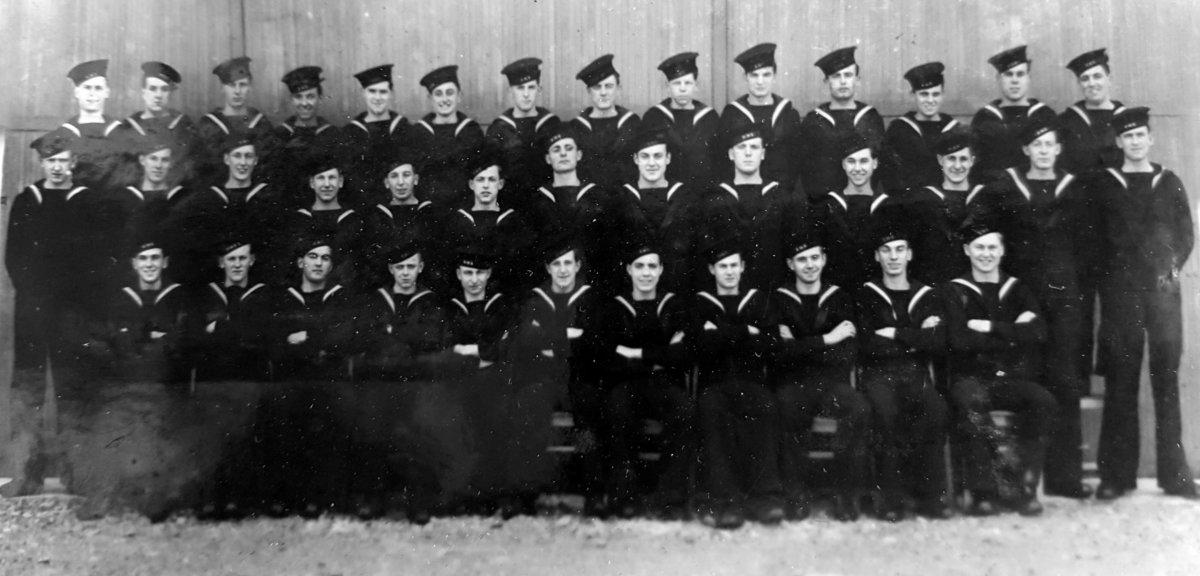
Course Photo - 45A (October 1943)
Gillison
(front row, 6th from left)






- World War I - Menu
- WWI Stories and Articles
- Photos - Yarmouth Soldiers
- Selection of World War I Songs
- WWI Casualties of Yarmouth, NS
- Those Who Served - Yarmouth, NS
- WWI Casualties Digby Co. NS
- WWI Casualties Shelburne Co. NS
- Merchant Mariners (1915) Yarmouth, NS
- Canadian Forestry Corps - Non Yarmouth Birth/Residence Enlistments
- US Draft Registry - Yarmouth NS Born


- World War II - Menu
- WWII Stories and Articles
- Telegraphist Air Gunners
- WWII Casualties of Nova Scotia
- US Casualties with NS Connection
- Far East/Pacific Casualties with NS Connection
- Merchant Navy Casualties Nova Scotia
- Nova Scotia WWII Casualties Holten Canadian War Cemetery
- D-Day Casualties - Nova Scotia
- CANLOAN Program Casualties - Nova Scotia
- Battle of the Bulge Casualties - Nova Scotia
- WWII Casualties Yarmouth NS
- Yarmouth Casualties - RCAF RAF Canadian Army WWII
- Yarmouth Co., Marrages WWII
- Casualties Non-Born/Residents with Connection to Yarmouth Co., Nova Scotia.
- WWII Casualties Digby Co., NS
- Non-Nova Scotian WWII Casualties Buried in Nova Scotia
- WWII RCAF Casualties Aged 16-18
- Brothers/Sisters Who Served - World War II