Remembering the Telegraphist Air Gunners
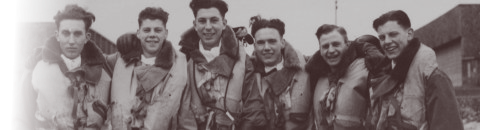

copyright © Wartime Heritage Association
Wartime Heritage
ASSOCIATION
Training for Telegraphist Air Gunners (TAGs) in the Fleet Air Arm Royal Navy (WWII)
Telegraphist Air Gunners (TAGs) of the Royal Navy’s Fleet Air Arm followed a well defined and highly structured training
pathway during the Second World War. This process transformed civilian recruits into fully qualified aircrew capable of
performing wireless communication, airborne telegraphy, and defensive gunnery duties in naval aircraft. Although the exact
sequence varied slightly depending on wartime pressures and training capacity, the core stages remained consistent
throughout the conflict.
The process began with enlistment and initial processing at a local recruiting centre, where new entrants underwent medical
examinations, administrative checks, and uniform issue. From there, they were drafted to a Royal Navy new-entry training
establishment to begin their transformation into naval ratings. The primary location for this phase was HMS Royal Arthur in
Skegness, which served as a major reception and basic training depot. Recruits spent approximately five to six weeks
learning naval discipline, parade drill, physical training, kit maintenance, firefighting basics, and the customs and routines of
naval life. This stage ensured that all future aircrew possessed the foundational discipline and naval identity required for
service.
Upon completion of basic training, prospective aircrew were transferred
to HMS St Vincent in Gosport, the Fleet Air Arm’s principal preliminary
training establishment for new ratings. Here, trainees underwent
aptitude testing to determine their suitability for aircrew roles, including
assessments in mathematics, Morse code potential, coordination, and
general academic ability. Classroom instruction introduced them to
aircraft recognition, elementary wireless principles, and the expectations
of naval aviation. This stage served as the gateway into specialist aircrew
categories, including the Telegraphist Air Gunner branch.
After classification at St Vincent, TAG trainees proceeded into one of two
main specialist training routes. The first and most traditional route kept
trainees within the United Kingdom. These individuals were drafted to
HMS Daedalus at Lee on Solent, the Fleet Air Arm’s central shore air
station and a major hub for wireless and telegraphy instruction. At
Daedalus, trainees received intensive training in Morse code, airborne
wireless operation, radio equipment handling, fault finding, and naval air communication procedures. They also received
early flying experience and introductory air gunnery instruction, preparing them for the more advanced stages to follow.
The second route, increasingly common from 1942 onward, sent TAG trainees overseas to RCAF Station Yarmouth (East
Camp) in Nova Scotia, part of the British Commonwealth Air Training Plan. This location offered a combined curriculum that
integrated wireless training, air gunnery, and flying instruction in a single, streamlined programme. Trainees at Yarmouth
progressed through classroom work, ground school, live gunnery, and operational flying in aircraft such as the Fairey
Swordfish, Albacore, and Barracuda. This overseas route relieved pressure on crowded UK facilities and produced fully
trained TAGs ready for operational deployment.
For those who remained in the UK, the next stage after Daedalus was attendance at an Air Gunnery School, such as HMS
Kestrel or various RAF gunnery stations. Here, trainees learned to operate the Vickers K and Lewis guns, practised turret and
free gun mount drills, conducted camera gun exercises, and completed live fire training. This phase ensured that TAGs were
competent defensive gunners capable of protecting their aircraft during operations.
Both the UK and Canadian routes converged at the Operational Training Unit (OTU) stage. OTUs provided advanced flying
experience, anti submarine warfare training, navigation support, night flying, formation work, and realistic operational
exercises. This was the final step before aircrew qualification. Upon successful completion, trainees obtained the status as
fully trained Telegraphist Air Gunners.
The final stage was posting to an operational squadron. TAGs served aboard escort carriers, with Coastal Command units, or
in strike wings operating torpedo bombers and reconnaissance aircraft. Their duties included wireless communication,
navigation assistance, spotting, anti submarine patrols, and defensive gunnery. By this point, the long and demanding
training had prepared them for the complex and hazardous realities of naval aviation.
East Camp RCAF Station Yarmouth Nova Scotia, 1942-1945
Telegraphist Air Gunner Training and Wartime Operations
The training of Telegraphist Air Gunners at East Camp, RCAF
Station Yarmouth, Nova Scotia, began in January 1943 with
Course 45A. The TAG School in Canada was ‘fathered’ by
the training establishment at Royal Naval Air Station,
Worthy Down, Hampshire, England, where TAGs had been
trained since 1939. Commander Mudie and many of the
instructors moved to Yarmouth from Worthy Down. Other
TAG courses continued at Worthy Down until early 1944
after which East Camp in Yarmouth became the main
course.
New courses began at one month intervals, and with
courses lasting about nine months, some seven or eight
would run concurrently. Courses 45 to 71 began at
Yarmouth but early in 1945 when it began clear that the
end of the war was in sight, courses were discontinued and
Course 64 was the last to graduate. The disappointed
trainees in subsequent groups were returned to general
service. Some 570 TAGs graduated from East Camp,
Yarmouth. Of these 53 appear in the TAG ‘In Memoriam’
List.
It was late 1943 before the first Canadian trained TAGs
appeared in operational squadrons. After passing through a
Naval Operational Training Unit, the majority of TAGs were
destined for Grumman Avenger aircraft, and the Pacific war
theatre. Others went to Fairey Barracuda aircraft, the
Navy’s other torpedo bomber. Several went to Fleet Requirement Units carrying out numerous roles including target towing
for ship and anti-aircraft gunnery trials, radar test flights and air-sea rescue duties.
Large pools of reserve aircrew were built up at Trincomalee in Ceylon and in Australia, awaiting the final assault on Japan.
Many Canadians trained TAGs were in Barracuda squadrons engaged in various attacks upon the Tirpitz and other targets in
Norway. Yet others joined 836 Squadron and flew in the venerated Swordfish. This squadron, large in numbers of aircraft
but never acting in one unit, provided the planes which operated from MAC ships in the North Atlantic and Russian convoy
operations. Finally, there were many Yarmouth trained TAGs in various Avenger squadrons which attacked Sumatra and the
Japanese Islands over a prolonged period.
The Instructors in Yarmouth included at least three survivors from the sinking of the carrier HMS Courageous; others were
pre-war TAGs who were brought back from the Reserve to pass on their skills and knowledge.
Course 68 and later courses had a large Canadian intake in preparation for the Royal Canadian Navy to man aircraft in HMCS
Warrior.
East Camp Yarmouth trained naval airmen with world wide connections and experience, a contribution to the war effort
which should not be forgotten.
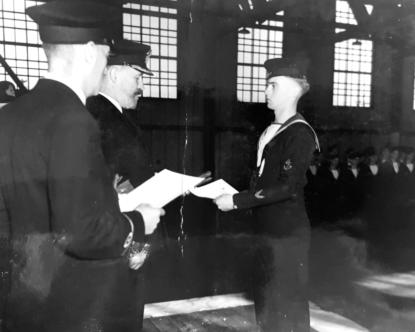
Photo: Yarmouth County Museum & Archives
The first Certificate presentation to Air Gunners passing
out from their course on September 19, 1944.
A/LA Hawkins, the top of Course 58, and the first pupil
ever to receive certificate recognition of the successful
completion of his course in Telegraphist-Air-Gunnery.
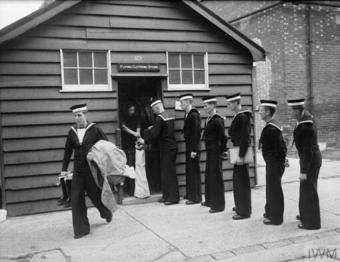
HMS St Vincent, August 5, 1943






- World War I - Menu
- WWI Stories and Articles
- Photos - Yarmouth Soldiers
- Selection of World War I Songs
- WWI Casualties of Yarmouth, NS
- Those Who Served - Yarmouth, NS
- WWI Casualties Digby Co. NS
- WWI Casualties Shelburne Co. NS
- Merchant Mariners (1915) Yarmouth, NS
- Canadian Forestry Corps - Non Yarmouth Birth/Residence Enlistments
- US Draft Registry - Yarmouth NS Born


- World War II - Menu
- WWII Stories and Articles
- Telegraphist Air Gunners
- WWII Casualties of Nova Scotia
- US Casualties with NS Connection
- Far East/Pacific Casualties with NS Connection
- Merchant Navy Casualties Nova Scotia
- Nova Scotia WWII Casualties Holten Canadian War Cemetery
- D-Day Casualties - Nova Scotia
- CANLOAN Program Casualties - Nova Scotia
- Battle of the Bulge Casualties - Nova Scotia
- WWII Casualties Yarmouth NS
- Yarmouth Casualties - RCAF RAF Canadian Army WWII
- Yarmouth Co., Marrages WWII
- Casualties Non-Born/Residents with Connection to Yarmouth Co., Nova Scotia.
- WWII Casualties Digby Co., NS
- Non-Nova Scotian WWII Casualties Buried in Nova Scotia
- WWII RCAF Casualties Aged 16-18
- Brothers/Sisters Who Served - World War II