
Wartime Heritage
ASSOCIATION
Remembering World War II
Archibald Joseph McIsaac

Name:
Archibald ‘Archie’ Joseph McIsaac
Rank:
Private
Service Number:
B/73171
Service:
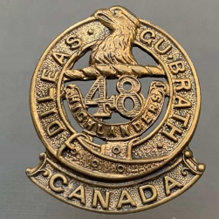
48th Highlanders of Canada, Royal Canadian Infantry Corps
Date of Birth:
October 30, 1920
Place of Birth:
New Waterford, Cape Breton Co., Nova Scotia
Date of Enlistment:
September 10, 1939
Place of Enlistment:
Toronto, Ontario
Age at Enlistment:
18
Address at Enlistment:
House of Providence, Toronto, Ontario
Height:
5 feet, 10 inches
Complexion:
Dark
Eye Colour:
Blue
Hair Colour:
Brown
Occupation:
Farmer, Harvest Hand
Marital Status:
Single
Next of Kin:
Mrs. Margaret Power (Sister), Charlotte St., Sydney, NS (at enlistment)
Sadie Martin (Sister), 26 Tobin Crt., Roxbury, Massachusetts
Religion:
Roman Catholic
Date of Death:
March 17, 1946
Age:
25
Cemetery:
St. Joseph Cemetery, West Roxbury, Suffolk Co., Massachusetts
Grave:
Grave Reference: Range 5, Section 7, Grave 185
Commemorated on Page 587 of the Second World War Book of Remembrance
Displayed in the Memorial Chamber of the Peace Tower in Ottawa on December 13
Archie was the son of Alexander McIsaac (1881-1921) and Margaret (MacDonald) McIsaac (1887-1930), of
New Waterford, Nova Scotia. His siblings were Angus, Susan McIsaac (d. 1931), Sarah ‘Sadie’ Anne (McIsaac)
Martin (1910-1989), Mary Ann McIsaac (b. 1912), Margaret (McIsaac) Powers (1916-2008), Duncan McIsaac
(b. 1918).
Archie’s father died when he was just a year old and his mother died when he was 9; he was brought up by
his older sister Sarah and an uncle.
Prior to enlistment in the spring of 1939, Archie was employed as a harvest hand in Ontario. Prior to that,
from 1935-1938, he worked as a clerk and delivery man for MacDougal Grocers in Port Hood, Cape Breton,
Nova Scotia, and for 6 months in 1938, he was a timberman and general labourer with the Dominion Coal
Company in New Waterford. His hope, post-war, was to work in mining. His interests included swimming,
skating, hockey (right wing), and baseball (short stop, second base).
He served in Canada, from September 10 to December 16, 1939, in England, from December 17 to June 13,
1940, in France from June 14 to June 17, 1940, and then he returned to England.
Archie took part in the Battle of France, embarking in Plymouth, England for Brest on June 13/14, 1940,
with the 48th Highlanders of Canada.
Archie and the 48th were part of the Second British Expeditionary Force (2nd BEF), and its attempt to
establish a new front in western France after the massive evacuations at Dunkirk had already concluded.
The 1st Canadian Infantry Brigade, which included the 48th, was rushed to Brittany with the intention of
holding a defensive "Breton Redoubt." However, the French collapse was moving far too quickly, rendering
the mission obsolete almost the moment the Canadians set foot on French soil.
The 48-hour deployment began on June 13, when the 48th Highlanders embarked from Plymouth, England,
aboard the SS El Mansour, a converted French vessel. They arrived at the port of Brest on June 14 and
immediately boarded trains to move inland toward Sablé-sur-Sarthe. No sooner had they unloaded their
equipment and begun to organize than the military situation deteriorated. With the French government on
the verge of surrender, the high command realized the Canadian brigade risked being cut off and
surrounded by advancing German armor.
The order was abruptly changed from advance to retreat, forcing the regiment to turn back toward the
northern coast. They rushed to the port of Saint-Malo, where a chaotic scene awaited them on the docks.
To ensure the advancing enemy couldn't utilize their heavy transport vehicles and excess equipment, the
Highlanders were forced to destroy their own gear on the waterfront. Archie and his comrades boarded the
SS Biarritz, slipping out of Saint-Malo on June 16 and arriving safely in Southampton the following day. This
rescue was carried out under Operation Ariel, the lesser-known sister evacuation to Dunkirk, and because
of the swift turnaround, the regiment miraculously suffered virtually no casualties during their brief foray
into France.
Back in the UK, Archie was absent without leave in London from March 11, until June 25, 1943, when he
was picked up by the Provost Corps and returned to the 48th Highlanders. On July 6th he escaped unit
custody and was AWL until Jan 27, 1944, when he surrendered himself to the Canadian Provost Corps in
London. He had spent most of his time in Manchester, and found local employment. Having returned to the
Army, Arrchie was confined and a medical assessment was done. On April 14, 1944, he was released from
the Canadian Detention Barracks, to a Canadian General Hospital due to pulmonary tuberculosis.
He returned to Canada in May of 1944, and was disharged from military service on July 22, 1944, due to his
medical condition.
Archie died of pulmonary tuberculosis at
the Queen Alexandra Hospital in London,
Ontario on March 17, 1946. His death was
determined to be due to his military
service.
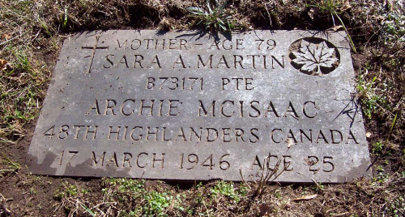
His headstone includes the name of Sara A.
Martin, and it reads, ‘Mother – Age 79’, but
Sarah was his older sister who helped raise
him, his mother having died when he was
9.
copyright © Wartime Heritage Association
Website hosting courtesy of Register.com - a web.com company






- World War I - Menu
- WWI Stories and Articles
- Photos - Yarmouth Soldiers
- Selection of World War I Songs
- WWI Casualties of Yarmouth, NS
- Those Who Served - Yarmouth, NS
- WWI Casualties Digby Co. NS
- WWI Casualties Shelburne Co. NS
- Merchant Mariners (1915) Yarmouth, NS
- Canadian Forestry Corps - Non Yarmouth Birth/Residence Enlistments
- US Draft Registry - Yarmouth NS Born


- World War II - Menu
- WWII Stories and Articles
- Telegraphist Air Gunners
- WWII Casualties of Nova Scotia
- US Casualties with NS Connection
- Far East/Pacific Casualties with NS Connection
- Merchant Navy Casualties Nova Scotia
- Nova Scotia WWII Casualties Holten Canadian War Cemetery
- D-Day Casualties - Nova Scotia
- CANLOAN Program Casualties - Nova Scotia
- Battle of the Bulge Casualties - Nova Scotia
- WWII Casualties Yarmouth NS
- Yarmouth Casualties - RCAF RAF Canadian Army WWII
- Yarmouth Co., Marriages WWII
- Casualties Non-Born/Residents with Connection to Yarmouth Co., Nova Scotia.
- WWII Casualties Digby Co., NS
- Non-Nova Scotian WWII Casualties Buried in Nova Scotia
- WWII RCAF Casualties Aged 16-18
- Brothers/Sisters Who Served - World War II


