copyright © Wartime Heritage Association
Website hosting courtesy of Register.com - a web.com company
Wartime Heritage
ASSOCIATION
Remembering World War II

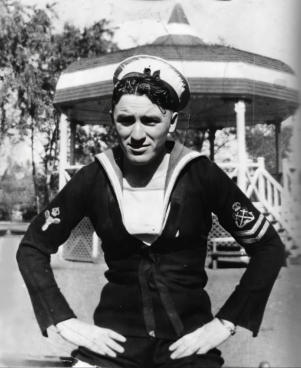
Basil Matthew Laidlaw

Name:
Basil Matthew Laidlaw
Rank:
Stoker Petty Officer
Service Number:
21350
Service:
HMS Belmont and HMS Calliope,
Royal Canadian Navy
Service Number:
21350
Date of Birth:
July 19, 1912
Place of Birth:
Port Hood, Inverness Co.,
Cape Breton, Nova Scotia
Enlistment:
September 1, 1933 (Halifax, NS)
Date of Death:
January 31, 1942
Age:
29
Memorial:
Halifax Memorial, Nova Scotia
Reference:
Panel 5
Commemorated on Page 88 of the Second World War Book of Remembrance
Displayed in the Memorial Chamber of the Peace Tower in Ottawa on February 25
Basil was the son of John Henderson Laidlaw (1870-1949) and Mary Florence (Fraser) Laidlaw (1874-1931),
Port Hood, Nova Scotia.
His siblings were Helena B U Laidlaw (b. 1901), Elizabeth Josephine Laidlaw (1904-1985), Robina Marie
Olga Laidlaw (1906-1985), Alexander Fraser Laidlaw (1908-1980), John H Laidlaw (b. 1909),
Margaret Laidlaw (b. 1911), Vesta Laidlaw (b. 1915), and Mary Laidlaw (1918-2008).
Basil was a sportsman and outdoors person. He enjoyed hunting and fishing. He completed the 10th Grade
and worked for two years as a bank teller at the Bank of Montreal in Port Hood.
He had interest in boxing and sports in general and his interests and habits centered around the sports
world. His father trained him to box, and he was always fussing over his weight and never smoke or drank.
He also had a great love for music. He played records by the hour and had a lovely singing voice himself.
He would visit friends and relatives and bring home the latest stories and songs.
He joined the Royal Canadian Navy in 1933. During these years he traveled the world and had many
fascinating trips. He also managed to visit his sisters Helen in California, Libby in Alberta and Robina in New
York, as well as several visits to the family who lived closer. Other trips saw him attend the Coronation of
George VI in England and a trip to his father's home in Scotland.
He was good to write letters and stayed connected with all his family. He loved to take pictures and made
up several albums of his journeys in the Caribbean and elsewhere. Basil had left a trunk with his personal
belongings at his sister Marguerite's home in Halifax.
On April 16, 1935, he reached the peak of his boxing career on winning the British Empire Championship in
Hamilton, Bermuda.
His home base was Halifax where he kept his belongings including a motorcycle which he used while on
shore. When the war broke out in Europe many Canadian service men were loaned to the British forces.
Ships assigned to and postings:
Oct 28, 1933
Served in HMCS Champlain until December 3, 1935
* Rated Stoker First Class September 1, 1934
January 11, 1936
Served in HMCS Saguenay until May 31, 1938
May 9, 1939
Served in HMCS Skeena until 28 February 28, 1941
* Rated Acting Leading Stoker June 15, 1940
July 14, 1941
Served in HMCS Hamilton until November 20, 1941
* Rated Acting Stoker Petty Officer August 1, 1941
November 24, 1941
Served in HMCS Vegreville until December 10, 1941
December 11, 1941
Served in HMCS Grandmère until Jan 11, 1942
January 25, 1942
Drafted to HMS Calliope, Royal Navy base, Gateshead, Tyne and Wear, England
January 25, 1942
Assigned to HMS Belmont for passage to HMS Calliope
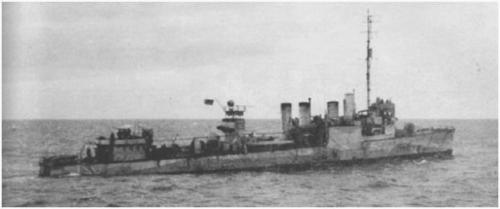
HMS Belmont was a Town‑class destroyer serving with the Royal Navy as a convoy escort during the Battle
of the Atlantic. She had begun her life as the USS Satterlee (DD‑190), a Clemson‑class destroyer
commissioned into the United States Navy in 1919. After a short early career and years in reserve, she was
reactivated for the Second World War and transferred to Britain in 1940. This transfer was part of the
“Destroyers for Bases” Agreement, through which fifty U.S. destroyers were exchanged for British base
rights in the Western Hemisphere- ships that became known in Royal Navy service as the Town‑class.
Renamed Belmont, she continued escort duties until she was torpedoed and sunk on January 31, 1942.
In November 1941, Belmont sailed for St. John's, Newfoundland to carry out local escort duties in Canadian
waters. On January 30, 1942, Belmont left Halifax, Nova Scotia, forming, together with the destroyer
Firedrake, the escort for the troopships Volendam and Largs Bay as Convoy NA2 bound for the Clyde. The
two destroyers were on opposite flanks of the convoy, with the troopships in line abreast. At 2212 hr on
January 31, 1942, explosions were spotted near Belmont by Volendam, and the Convoy commodore
ordered the convoy to alter course away from the explosions on the assumption that Belmont was engaging
a submarine. When the convoy resumed its course at 2250 hrs, with no sight of or signals from Belmont, it
was realised that the destroyer must have been torpedoed. Firecrest remained with the convoy rather
than turning back to search for survivors, as that would have left the convoy unprotected. An air search for
survivors was hampered by bad weather, and no survivors were found. Belmont had been torpedoed and
sunk by the German U-boat U-82 with all 138 on board being killed. U-82 herself was sunk with all hands on
February 6, 1942.
Basil Matthew Laidlaw was among the 138 lost in the sinking of HMS Belmont.






- World War I - Menu
- WWI Stories and Articles
- Photos - Yarmouth Soldiers
- Selection of World War I Songs
- WWI Casualties of Yarmouth, NS
- Those Who Served - Yarmouth, NS
- WWI Casualties Digby Co. NS
- WWI Casualties Shelburne Co. NS
- Merchant Mariners (1915) Yarmouth, NS
- Canadian Forestry Corps - Non Yarmouth Birth/Residence Enlistments
- US Draft Registry - Yarmouth NS Born


- World War II - Menu
- WWII Stories and Articles
- Telegraphist Air Gunners
- WWII Casualties of Nova Scotia
- US Casualties with NS Connection
- Far East/Pacific Casualties with NS Connection
- Merchant Navy Casualties Nova Scotia
- Nova Scotia WWII Casualties Holten Canadian War Cemetery
- D-Day Casualties - Nova Scotia
- CANLOAN Program Casualties - Nova Scotia
- Battle of the Bulge Casualties - Nova Scotia
- WWII Casualties Yarmouth NS
- Yarmouth Casualties - RCAF RAF Canadian Army WWII
- Yarmouth Co., Marriages WWII
- Casualties Non-Born/Residents with Connection to Yarmouth Co., Nova Scotia.
- WWII Casualties Digby Co., NS
- Non-Nova Scotian WWII Casualties Buried in Nova Scotia
- WWII RCAF Casualties Aged 16-18
- Brothers/Sisters Who Served - World War II