copyright © Wartime Heritage Association
Website hosting courtesy of Register.com - a web.com company
Wartime Heritage
ASSOCIATION
Remembering World War II
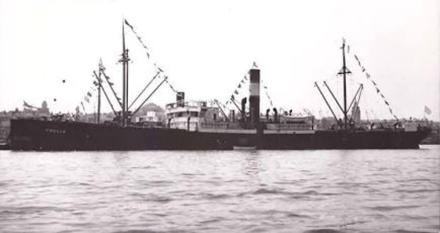
SS Thalia


SS Thalia
The SS Thalia was a Greek-registered cargo steamer of 5,875 tons built in 1917. She was built as War Lion for Furness Withy & Co.,
renamed the Jebba in 1919 for African SS Co., laid up in 1930 laid up, and sold to Greece and renamed Thalia in 1933, Tramp
Development Co., London.
On October 19, 1940, the SS Thalia was sailing with the 34-ship
SC-7 convoy from Montreal, Quebec, to Garston, England, when
she was torpedoed at 01:55 a.m. by U-99 west of the British Isles
in the North Atlantic. She sank in 40 seconds at position
57°00'N/11°30'W. The attack killed 22 crew members. The four
survivors were rescued by the Norwegian cargo ship Snefjeld.
The sinking of the Greek merchantman SS Thalia was a brutal
piece of a much larger, historic tragedy. Convoy SC-7 remains
one of the most infamous convoy disasters of the entire Battle of
the Atlantic, marking the terrifying debut of the German U-boat
"wolfpack" tactics. This specific convoy consisted of slow-moving
merchant vessels carrying vital war materials like timber, grain, and steel across the North Atlantic. Enemy German submariners
referred to October 1940, as the "First Happy Time," a period when Allied escorts were far too few, lacked coordinated anti-
submarine tactics, and were operating without widespread radar technology.
The sudden attack on the Thalia highlights just how devastatingly efficient these wolfpack strikes could be. The attacker, U-99, was
commanded by Otto Kretschmer, one of Germany's top submarine captains. Kretschmer was known for a brazen tactic where he
would slip directly inside the columns of a convoy at night on the surface, making it incredibly difficult for escort vessels to detect
him or fire back without risking hitting their own ships. Because the Thalia went down in a mere 40 seconds after the torpedo
struck, the crew had absolutely no time to launch lifeboats or properly abandon ship. Most of the 22 men who perished were likely
trapped below deck or pulled down by the suction of the fast-sinking hull.
The four survivors owed their lives to the crew of the Norwegian cargo ship Snefjeld, a fellow member of the convoy that managed
to pull them from the freezing water. Stopping to pick up survivors in the middle of an active U-boat raid required immense bravery,
as a stationary merchant ship became an easy target for a torpedo. By the time the assault on Convoy SC-7 finally ended a few days
later, the German wolfpack had successfully sunk 20 of the 34 ships, a catastrophic loss that forced the Allies to completely
revolutionize how they organized and defended transatlantic supply lines.
Among the 22 casualties of the SS Thalia, were two men with ties to Nova Scotia. They are remembered on the Halifax Memorial at
Point Pleasant Park in Halifax, Nova Scotia, on Panel 17.
Name:
Charles Gilbert Heath
Rank:
Chief Radio Officer
Date of Birth:
Between Apr-June 1893
Place of Birth:
Southport, Lancashire, England
Date of Death:
October 18, 1940
Age:
47
Commemorated on Page 154 of the Merchant Navy Book of Remembrance
Displayed in the Memorial Chamber of the Peace Tower in Ottawa on March 29, August 26, and November 1
Charles was the son of Charles Douglas Heath (1870-1912) and Ellen (Herron) Heath (b. 1879) of Ormskirk,
Lancashire, England, the husband of Ariel Galena Lee (Seaboyer) Heath (1897-1960), and the father of Clyde
Stanley Heath (1931-2001).
Aeriel was born in Jordan River, Shelburne Co., Nova Scotia, the daughter of George Stanley Seaboyer (1865-
1963), and Hannah Bertha (Crowell) Seaboyer (1865-1948). Charles and Aeriel were married December 10,
1925, in Jordan Falls in Shelburne Co.
Name:
Earl David Cantwell
Rank:
Trimmer
Date of Birth:
February 8, 1918
Place of Birth:
Bras d’Or, Cape Breton Co., Nova Scotia
Age:
21
Commemorated on Page 154 of the Merchant Navy Book of Remembrance
Displayed in the Memorial Chamber of the Peace Tower in Ottawa on March 5 and August 2
Earl was the son of Francis ‘Frank’ Cantwell Jr. (1890-1943) and Mary Theresa (McGrath) Cantwell (1895-
1955), of Bras d’Or, Cape Breton County, Nova Scotia. He was from a large family with over a dozen children.
Earl’s brother Private Russell Cantwell (Service Number F/97720), West Nova Scotia Regiment, was killed in
action on December 18, 1943, in Italy and is interred at the Moro River War Cemetery.







- World War I - Menu
- WWI Stories and Articles
- Photos - Yarmouth Soldiers
- Selection of World War I Songs
- WWI Casualties of Yarmouth, NS
- Those Who Served - Yarmouth, NS
- WWI Casualties Digby Co. NS
- WWI Casualties Shelburne Co. NS
- Merchant Mariners (1915) Yarmouth, NS
- Canadian Forestry Corps - Non Yarmouth Birth/Residence Enlistments
- US Draft Registry - Yarmouth NS Born


- World War II - Menu
- WWII Stories and Articles
- Telegraphist Air Gunners
- WWII Casualties of Nova Scotia
- US Casualties with NS Connection
- Far East/Pacific Casualties with NS Connection
- Merchant Navy Casualties Nova Scotia
- Nova Scotia WWII Casualties Holten Canadian War Cemetery
- D-Day Casualties - Nova Scotia
- CANLOAN Program Casualties - Nova Scotia
- Battle of the Bulge Casualties - Nova Scotia
- WWII Casualties Yarmouth NS
- Yarmouth Casualties - RCAF RAF Canadian Army WWII
- Yarmouth Co., Marriages WWII
- Casualties Non-Born/Residents with Connection to Yarmouth Co., Nova Scotia.
- WWII Casualties Digby Co., NS
- Non-Nova Scotian WWII Casualties Buried in Nova Scotia
- WWII RCAF Casualties Aged 16-18
- Brothers/Sisters Who Served - World War II