copyright © Wartime Heritage Association
Website hosting courtesy of Register.com - a web.com company
Wartime Heritage
ASSOCIATION

Remembering World War II
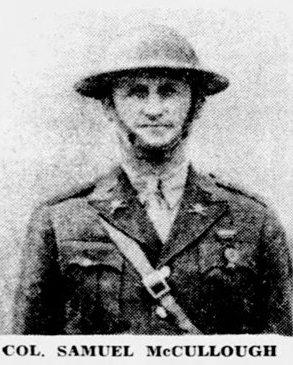
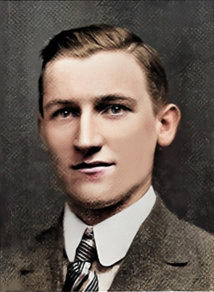
Samuel McCullough

Name:
Samuel McCullough
Rank:
Colonel
Service Number:
O-009816
Service:
60th Coast Artillery Regiment, US Army
Awards:
Legion of Merit, Prisoner of War Medal,
Purple Heart,
McCullough Road at Fort Baker named in his honor and memory
Date of Birth:
June 14, 1896
Place of Birth:
Waltham, Middlesex County, Massachusetts
Date of Enlistment:
October 1917
Place of Enlistment:
Massachusetts
Address at Enlistment:
Massachusetts
Age at Enlistment:
20
Height:
6 feet
Complexion:
Ruddy
Eye Color:
Blue
Hair Color:
Brown
Occupation:
Served in the US Army in WWI, and in the interwar period
Marital Status:
Married
Religion:
Protestant
Next of Kin:
Helen B. McCullough (Wife), 1301 West 13th Street, Austin, Texas
Date of Death:
September 1, 1942
Age:
46
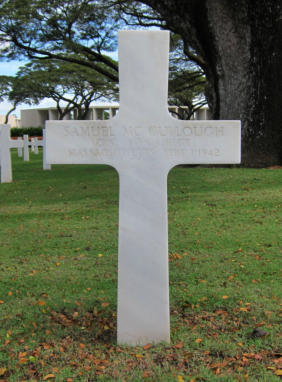
Cemetery:
Manila American Cemetery, Manila, Philippines
Grave:
Plot A, Row 11, Grave 83
Samuel ‘Mac’ McCullough was the son of John McCullough (1863-1944), and Ella Blackie (Falconer) McCullough
(1870-1905) born in Greenhill, Pictou County, Nova Scotia. He was the husband of Helen Donesta (Hendrickson)
McCullough, and the father of Mary Cecelia (McCullough) Carroll Hancock (1920-2019) and Kathleen "Kitty"
Adair (McCullough) Kotzebue (1922-1997).
Samuel’s first cousin, Rear Admiral Leonard W. Murray (1896-1971), CB, CBE, served in the Royal Canadian
Navy, and played a significant role in the Battle of the Atlantic. He commanded the Newfoundland Escort Force
from 1941-43, and from 1943 to the end of the war was Commander-in-Chief, Canadian Northwest Atlantic. He
was the only Canadian to command an Allied theatre of operations during both the First and Second World War.
Both of his brothers-in-law also served in the US Armed Forces.
Samuel’s grandson, United States Air Force Major John Leonard Carroll, DFC (1940-1972), the son of his
Samuel’s sister Mary, was killed in the Vietnam War on November 7, 1972, serving with the 56th Special
Operations Wing, 20th Tactical Air Support Squadron, and flying from the Udorn Royal Thai Air Base in Thailand.
Samuel graduated from Weston High School, Weston, Massachusetts in 1914, and from the Co-operative School
of Engineering of Northeastern College in Boston, Mass. with a degree in Electrical Engineering in 1917.
He had a lengthy and varied military career at multiple posts which included the following:
Coast Artillery Corps, commissioned Oct 1917
Fort Strong, Massachusetts – Apr-Oct 1918
Camp Eustis, Virginia – Oct 1918-Jan 1921
Fort Kamehameha, Pearl Harbor defenses, Queen Emma Pt., Honolulu, Hawaii – Feb 1921-Feb 1924
Fort Eustis, Virginia – Feb 1924-Aug 1928 (promoted Captain, May 1928)
Coast Artillery School, Fort Monroe, Virginia – Sep 1928-Aug 1929
Fort Mills, Philippine Islands – Oct 1929-Jul 1932
Fort Sheridan, Illinois – Aug 1932-May 1935 (Battery E, then Battery A, 61st Coast Artillery)
CCC duty, Michigan – Apr-May 1935
National Guard Instructor, Concord, New Hampshire – Jun 1935-Sep 1938 (promoted Major, Jul 1937)
Command & General Staff School, Fort Leavenworth, Kansas – Sep 1938-Jun 1939
Chemical Warfare School, Edgewood Arsenal, Maryland – Jun-Aug 1939
Governors Island, New York – Aug 1939
Harbor Defenses of Manila & Subic Bays, Fort Mills, Philippines – Oct 1939-Dec 1939
An excerpt, ‘A Parade Ground – day’ from ‘Your Grandfather’s Saber – a Century of Sacrifice’ by David Kotzebue
recounts an incident from Sam McCullough’s time while stationed at Fort Kamehameha, part of the coastal
artillery defenses of Pearl, in Hawaii in 1924.
“An Army parade ground, Fort Kamehameha, Hi., ca. 1924.
A crowd of civilians and military brass assembles in bleachers. A voice blares over the loudspeakers.
Voice: Good morning, distinguished visitors and family members of the officers and men of the 31st
Calvary Battalion and the 12th Coast Artillery Detachment, Ft. Kamehameha, Hawaii. Today's parade
marks the graduation of a new class of recruits from Basic Training.
Ladies and Gentlemen: I give you the 31st Calvary Battalion and the 12th Coast Artillery Detachment.
The crowd scans the parade ground. A cadre of officers and flag-bearers march from the barracks. They
take their position in the center of the parade ground, in front of the bleachers.
The Army band begins to play, "Pass in Review."
A Calvary company rides forth from the portal of the barracks. The crowd in the bleachers applauds.
More Calvary companies follow. They circle the parade field. Horse-drawn Field Artillery cannons
follow. They near the bleachers.
Helen McCullough, a 20-something, red-headed Army wife, watches from the bleachers. She holds Kitty,
her 3-year-old red-headed daughter, as well as Mary, her 5-year-old red-headed daughter. Helen tries to
keep Kitty from squirming.
At the head of the first Cavalry company rides Capt. Samuel McCullough, He's a tall, thin, red-headed
Army officer. Helen's husband and Kitty's father.
Helen McCullough (Pointing): Look, Kitty, there's daddy!
Kitty: Daddy!
Kitty squirms loose from her mother and toddles out towards her father and the approaching horses.
The crowd in the bleachers rises to their feet. They gasp and point as Kitty toddles towards the
oncoming calvary. Mary jumps and applauds. Sam sees the approaching toddler. In one movement, he
reaches down. He swoops her from the ground. He rides in front of the battalion commander. He salutes
with one hand and holds Kitty with the other. Kitty mimics her father and salutes, too. The crowd
laughs and applauds. The battalion commander salutes Sam and Kitty back.
Battalion Commander: Looks like you've got another redhead on your hands, Captain McCullough.
Sam rides past. He holds his daughter on his lap in front of him.
Sam: Indeed, I do, sir; indeed, I do. He finishes his salute. Kitty mimics her father. They ride past the
reviewing stand.
He sings to Kitty under his breath.
Sam: This is the Army, Miss McCullough.
After a number of posts in the continental United States and Hawaii and a posting in the Philippines from 1929-
1932, Samuel was assigned to Harbor Defenses of Manila and Subic Bays at Fort Mills in the Philippines prior to
America’s involvement in World War II, in 1939.
When Samuel McCullough arrived in the Philippines in October 1939, he joined the Harbor Defenses of Manila
and Subic Bays as Intelligence and Publicity Officer, a role that
placed him at the centre of the American defensive
preparations on Corregidor as tensions in the Pacific steadily
worsened. What began as a routine overseas posting quickly
transformed into a desperate struggle for survival when Japan
invaded in December 1941. McCullough served throughout the
siege, later becoming Executive Officer for Beach Defense, one
of the senior officers responsible for coordinating the island’s
final resistance. Ill and already hospitalized with urinary
complications and amebic dysentery at the Fort Mills station
hospital in Corregidor, he was captured when Corregidor fell
on May 6, 1942, and was transferred to Bilibid Prison in Manila
with other sick and wounded prisoners of war. There, amid
deprivation, malnutrition, and inadequate medical care, he
succumbed to carcinoma and starvation on September 1, 1942,
at 0635 hours.
After the war his remains were disinterred and brought to
7747 USAF Cemetery, Manila #2, Philippine Islands where they
were reburied on June 13, 1945 – Block 1, Row 14, Grave 1730 (D-D Number 8563). The deceased in Manila #2
(over 11,000 American soldiers) rested there until their removal to the American Graves Registration Service
Manila Mausoleum in the summer of 1948. From there, according to the wishes of his next of kin (daughter,
Mrs. Mary C. Carroll), Colonel Samuel McCullough was buried in his final resting place "side by side with
*comrades who also gave their lives for their country" in 7701 Fort William McKinley Military Cemetery (now
known as the Manila American Cemetery) – Plot A, Row 11, Grave 83. Customary military funeral services were
conducted over the grave at the time of burial.







- World War I - Menu
- WWI Stories and Articles
- Photos - Yarmouth Soldiers
- Selection of World War I Songs
- WWI Casualties of Yarmouth, NS
- Those Who Served - Yarmouth, NS
- WWI Casualties Digby Co. NS
- WWI Casualties Shelburne Co. NS
- Merchant Mariners (1915) Yarmouth, NS
- Canadian Forestry Corps - Non Yarmouth Birth/Residence Enlistments
- US Draft Registry - Yarmouth NS Born


- World War II - Menu
- WWII Stories and Articles
- Telegraphist Air Gunners
- WWII Casualties of Nova Scotia
- US Casualties with NS Connection
- Far East/Pacific Casualties with NS Connection
- Merchant Navy Casualties Nova Scotia
- Nova Scotia WWII Casualties Holten Canadian War Cemetery
- D-Day Casualties - Nova Scotia
- CANLOAN Program Casualties - Nova Scotia
- Battle of the Bulge Casualties - Nova Scotia
- WWII Casualties Yarmouth NS
- Yarmouth Casualties - RCAF RAF Canadian Army WWII
- Yarmouth Co., Marriages WWII
- Casualties Non-Born/Residents with Connection to Yarmouth Co., Nova Scotia.
- WWII Casualties Digby Co., NS
- Non-Nova Scotian WWII Casualties Buried in Nova Scotia
- WWII RCAF Casualties Aged 16-18
- Brothers/Sisters Who Served - World War II