copyright © Wartime Heritage Association
Website hosting courtesy of Register.com - a web.com company
Wartime Heritage
ASSOCIATION

Charles Stuart Livingstone

Remembering World War II
Name:
Service No:
Rank:
Service:
Date of Birth:
Place of Birth:
Date of Enlistment:
Place of Enlistment:
Address at Enlistment:
Age at Enlistment:
Height:
Complexion:
Eye Color:
Hair Color:
Trade:
Religion:
Marital Status:
Next of Kin:
Date of Death:
Age at Death:
Cemetery:
Grave Reference:
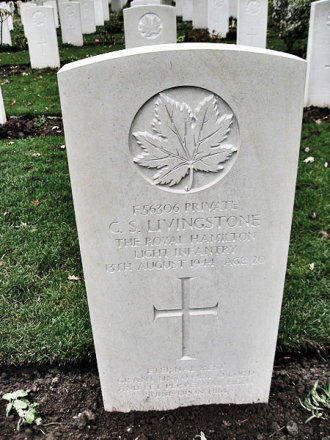
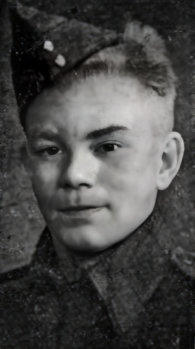
Charles Stuart Livingstone
F/56306
Private
Royal Hamilton Light Infantry, R.C.I.C.
October 14, 1923
Victoria Mines, Cape Breton Co., Nova Scotia
February 22, 1943
Halifax, Nova Scotia
Victoria Mines, Cape Breton Co., Nova Scotia
19
5 feet, 6 inches
Reddish
Gray
Brown
Miner
Roman Catholic
Single
Meria Livingstone (Mother) Victoria Mines, NS
August 13, 1944
20
Beny-sur-Mer Canadian War Cemetery, France
VIII. G. 13.
Commemorated on page 367 of the Second World War Book of Remembrance
Displayed in the Memorial Chamber of the Peace Tower in Ottawa on August 5
Charles Stuart Livingstone was the son of George and Meria Livingstone, of Victoria Mines, Nova Scotia.
He left school at the age of 16 and was employed as a Miner until his enlistment in February 1943.
Charles completed his basic training at No 61 CIBTC, in New Glasgow, Nova Scotia, and his advanced
training at Aldershot, Nova Scotia. He departed Canada for the United Kingdom on April 30, 1944 and
disembarked there on May 5, 1944. Following training in England, he departed for France arriving there on
July 25, 1944.
On August 12, 1944, the Royal Hamilton Light Infantry (RHLI) of the 4th Canadian Infantry Brigade was
ordered to advance towards Clair Tison, Calvados, in Normandy, France.
“The RHLI passed Barbery, a hamlet of a few houses which was the half-way point. Nothing stirred there;
not a person or farm animal...The men waded through the unharvested wheat on each side of the road.
The field narrowed about a thousand yards beyond Barbery where woods closed in on each side of the
road. The men were sodden with sweat and chaff, and pollen clung to their trousers as they walked
resolutely through the woods. A breeze rustled the aspen and poplar, their whispers punctuated by the
odd clink of equipment and the whine and slap of the Shermans [tanks] coming up behind them. C
Company was the first to come under fire from machine guns in a copse to the left. Then all the rifle
companies were enveloped in a storm of bullets and shrapnel.”
Lyle Doering, the battalion Intelligence Officer, later recorded it as "the most intense mortaring and
shelling the unit ever witnessed.”
Serving with the Royal Hamilton Light Infantry on August 12, 1944, Private Livingston was severely
wounded in action during the Battle of Clair Tison on August 12, 1944, by shell shrapnel to the chest and
died the following day from the wounds received in action against the enemy.
The German counter-attacks were an attempt to
hold the Falaise pocket, but by dusk the Germans
withdrew. The Canadians had won, but at a cost of
20 soldiers killed and 100 wounded.
The following day, Private Livingstone was buried in
Saint-Germain-La-Blanche-Herbe in Calvados,
Normandy, France, and was later reburied in the
Beny-Sur-Mer Canadian War Cemetery in Calvados
after the end of the war.






- World War I - Menu
- WWI Stories and Articles
- Photos - Yarmouth Soldiers
- Selection of World War I Songs
- WWI Casualties of Yarmouth, NS
- Those Who Served - Yarmouth, NS
- WWI Casualties Digby Co. NS
- WWI Casualties Shelburne Co. NS
- Merchant Mariners (1915) Yarmouth, NS
- Canadian Forestry Corps - Non Yarmouth Birth/Residence Enlistments
- US Draft Registry - Yarmouth NS Born


- World War II - Menu
- WWII Stories and Articles
- Telegraphist Air Gunners
- WWII Casualties of Nova Scotia
- US Casualties with NS Connection
- Far East/Pacific Casualties with NS Connection
- Merchant Navy Casualties Nova Scotia
- Nova Scotia WWII Casualties Holten Canadian War Cemetery
- D-Day Casualties - Nova Scotia
- CANLOAN Program Casualties - Nova Scotia
- Battle of the Bulge Casualties - Nova Scotia
- WWII Casualties Yarmouth NS
- Yarmouth Casualties - RCAF RAF Canadian Army WWII
- Yarmouth Co., Marriages WWII
- Casualties Non-Born/Residents with Connection to Yarmouth Co., Nova Scotia.
- WWII Casualties Digby Co., NS
- Non-Nova Scotian WWII Casualties Buried in Nova Scotia
- WWII RCAF Casualties Aged 16-18
- Brothers/Sisters Who Served - World War II