Wartime Heritage
ASSOCIATION

copyright © Wartime Heritage Association
Website hosting courtesy of Register.com - a web.com company
The Mystery of the Purple Heart

The Wartime Heritage Association is dedicated to preserving and sharing the stories of Second World War casualties with ties to
Nova Scotia. Recently a wartime artifact came to our attention.
A Purple Heart inscribed with the name Roger B. Nolan was found in Chegoggin, Yarmouth County. The mystery of how his
medal found its way to Yarmouth, and whether Nolan had any personal connection to Nova Scotia led us to uncover the man
behind the name, learn his story, and share it.
Name:
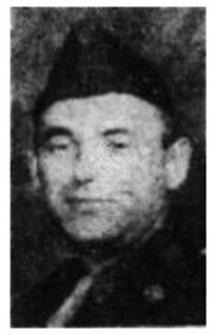
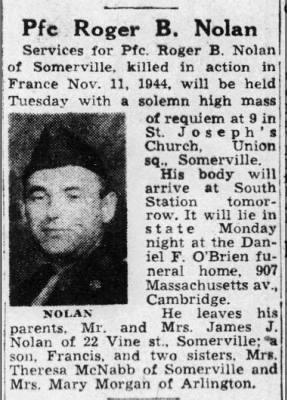
Roger Barry Nolan
Rank:
Private First Class
Service Number:
31426763
Service:
Company D, 317th Infantry Regiment, 80th Division,
US Army
Date of Death:
November 11, 1944
Age:
32
Cemetery:
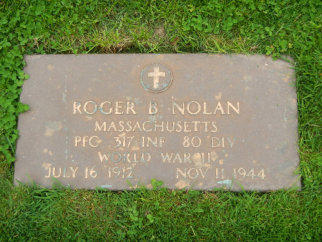
Somerville Veterans Cemetery, Somerville, Massachusetts
Grave:
Section IV, WWII
Roger was born July 16, 1912 in Cambridge, Middlesex Co., Massachusetts, the son of
James Joseph Nolan (1875-1955) and Ellen (Moran) Nolan (1879-1955), originally of
Northern Ireland, and three siblings, Mary Agnes (Nolan) Morgan (1909-1991), Teresa
Margaret (Nolan) McNabb (1912-1987), and Matthew Nolan (1916-1919).
In 1920, his parents and two sisters were living on Tyler Street in Somerville, Mass.
Roger registered for the US Draft on October 16, 1940, in Somerville, Middlesex Co., Massachusetts, while working for the
Mitchell Baking Company at 29 Vine Street in Somerville. He and his parents were living at 22 Vine Street.
He had completed 2 years of high school and was employed as an electrician before he enlisted on November 24, 1943, in
Boston, Mass.; age 31. He was 6 feet, 1 inch tall, with a ruddy complexion, black hair, and brown eyes.
Roger had married Rita Catherine Navarro (1918-2008) 1943 prior to enlistment. After Roger’s death, Rita later remarried
Charles J. O’Connor Sr. (1908-1988) in 1947.
Reactivated on July 15, 1942, the 317th Infantry Regiment was rebuilt as part of
the 80th “Blue Ridge” Infantry Division, drawing, and training new soldiers for the
rapidly expanding U.S. Army. Over the next two years, the regiment moved
through a demanding sequence of training areas across Tennessee, Kansas,
Arizona, and California, refining its proficiency in small‑unit tactics, long‑distance
maneuvers, and combined‑arms coordination. Their final staging took place in New
Jersey before the regiment sailed for England in June 1944 to join the buildup for
the liberation of Europe.
Following the Normandy landings, the 317th entered combat in August 1944. Its
baptism of fire came during the closing of the Falaise Gap, where the regiment
helped seal the encirclement of German forces attempting to escape eastward.
From there, the 317th spearheaded elements of Third Army’s rapid advance across
France, pushing toward Nancy and engaging in a series of sharp actions that tested
the regiment’s cohesion and endurance. By early autumn, the regiment, like much
of Third Army, was slowed by the severe fuel shortages of the “October Pause,”
forced to hold exposed positions while awaiting resupply.
In November 1944, the 317th resumed offensive operations, fighting through the
outer defenses of the Maginot Line and preparing for the assault on the German
West Wall. These operations brought the regiment into the bitter, attritional fighting around Metz, where fortified villages,
canals, and entrenched German positions made every advance costly.
It was during this phase of the campaign, on November 10, 1944, that Roger Nolan was killed in action. He fell near Metz,
Moselle, France, while serving with the 317th Infantry Regiment in one of the most difficult and strategically significant battles
of the Lorraine campaign.
Roger’s body was repatriated to the United States at the family’s request,
rather than having him interred in an American Battle Monuments
Commission Cemetery overseas, and he was interred at the Somerville
Veterans Cemetery in Somerville in Boston, Middlesex Co., Mass. in the late
1940’s.
Despite exhaustive research by the Association, how his Purple Heart came
to be in Yarmouth and if he had a connection to Nova Scotia remains a
mystery.
Sources
findagrave






- World War I - Menu
- WWI Stories and Articles
- Photos - Yarmouth Soldiers
- Selection of World War I Songs
- WWI Casualties of Yarmouth, NS
- Those Who Served - Yarmouth, NS
- WWI Casualties Digby Co. NS
- WWI Casualties Shelburne Co. NS
- Merchant Mariners (1915) Yarmouth, NS
- Canadian Forestry Corps - Non Yarmouth Birth/Residence Enlistments
- US Draft Registry - Yarmouth NS Born


- World War II - Menu
- WWII Stories and Articles
- Telegraphist Air Gunners
- WWII Casualties of Nova Scotia
- US Casualties with NS Connection
- Far East/Pacific Casualties with NS Connection
- Merchant Navy Casualties Nova Scotia
- Nova Scotia WWII Casualties Holten Canadian War Cemetery
- D-Day Casualties - Nova Scotia
- CANLOAN Program Casualties - Nova Scotia
- Battle of the Bulge Casualties - Nova Scotia
- WWII Casualties Yarmouth NS
- Yarmouth Casualties - RCAF RAF Canadian Army WWII
- Yarmouth Co., Marrages WWII
- Casualties Non-Born/Residents with Connection to Yarmouth Co., Nova Scotia.
- WWII Casualties Digby Co., NS
- Non-Nova Scotian WWII Casualties Buried in Nova Scotia
- WWII RCAF Casualties Aged 16-18
- Brothers/Sisters Who Served - World War II