Remembering the Telegraphist Air Gunners
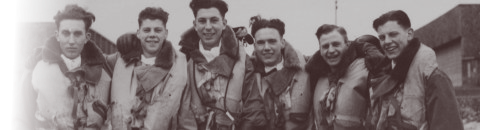

copyright © Wartime Heritage Association
Wartime Heritage
ASSOCIATION
TAG Course 59A - February 1944
Yarmouth,
Nova
Scotia
played
an
important
role
of
being
the
only
place
other
than
England
that
trained
Telegraphists
Air
Gunners
during
World
War
II.
February
1944
Course
59A
had
38
young
men
from
the
United
Kingdom
of
the
Fleet
Air
Arm
Royal
Navy
at
East
Camp,
RCAF
Station
Yarmouth.
The
course
actually
had
39
young
men.
One
UK
exception
was
a
Canadian,
born
in
Ontario,
Canada,
Robert
Norman
Edward
"Windy”
Geale.
Some
TAGS
in
the
UK
called
him
“Canada”
and
he
was
also
fondly
referred
to
as
“Windy”
since
hi
s last name is Geale (pronounced ‘gale’).
He
decided
to
join
the
Fleet
Air
Arm
Royal
Navy
and
he
was
shipped
to
England.
He
opted
to
become
a
Telegraphist
Air
Gunner
and
was
soon
off
to
HMS
ST.
VINCENT
to
start
his
TAG
training.
At
the
end
of
three
months
he
found
out
that
he
was
in
the
top
half
of
the
course
and drafted to Canada. “Frankly”, says Windy, “at the time I was not impressed”.
His first impression of East Camp, was “this isn’t a naval base it’s an air force base”. The
Fleet Air Arm was essentially the “Air force of the Navy” so this impression is
understandable. He moved into the bottom floor of a block, which fronted onto the raised
parade ground with a road running alongside. Situated on one side of the parade ground
was a large Hangar used for PT and basketball. The TAG School was across from his hut
where he soon ‘’got back into the Navy”.
Asked about memories of East Camp, Windy remembers one day looking out as a blimp
came in for a landing and suddenly but slowly it folded up in a lump on the Tarmac (This
incident was the crash of a US Naval Blimp). He remembers that the Swordfish were great
aircraft and you could always tell the amount of experience your pilot had. Junior pilots
wound up the wheels, all 167 turns themselves while more experienced called for the
student TAG do this for them.
After gaining his ‘wings’ in Yarmouth, training at East Camp, he went back to the UK via
New York and Le Havre, France. He remembers seeing a bit of the residue of the battered ports of France and German POWs
unloading allied ships.
“Then it was off to the Operational Training Unit to work up in a FAIREY Barracudas, a great dive Bomber with horrible PR, for the
Pacific”, says Windy. “My pilot was a Chief Petty Officer Pilot, one of the very best I have ever flown with”.
“When the war came to a sudden end the Observer disappeared back to Canada and my pilot, Ray Carter and I finished to OFT with
another Observer. At the beginning of 1946 I joined the Fleet Carrier HMS Formidable, in Portsmouth and left it in Colombo, Ceylon
to wait for my Squadron, 827, a Barracuda squadron to return from South Africa in HMS COLOSSUS a Light Fleet Carrier. In my
career I was to fly from 5 Light Fleet Carriers, the last being HMAS Melbourne. Joined the squadron up country in Ceylon at RNAS
Katakarunda and it was back to flying in Barracudas.”
After a long and fascinating Naval carrier of forty-three years, Bob “Windy” Geale went on to become Honorary Curator of the
Australian Museum of Flight in Nowra, New South Wales, Australia where he also resided.
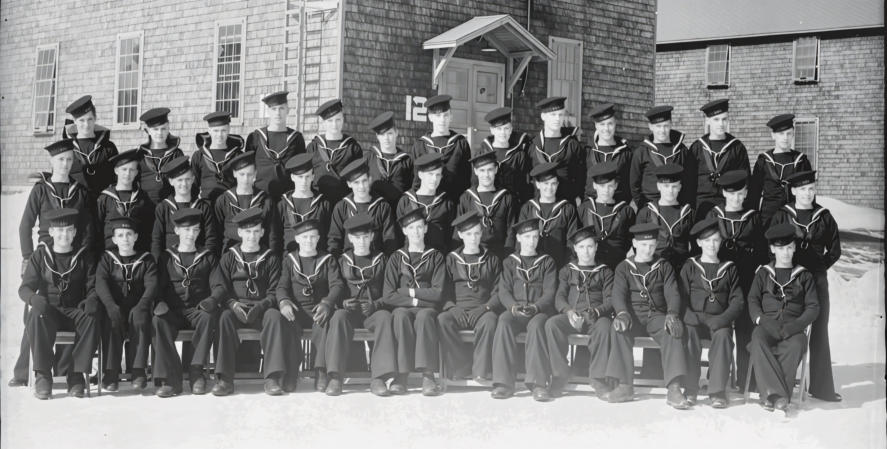
TAG Course 59A - February 1944
Course Photo - 59A February 1944
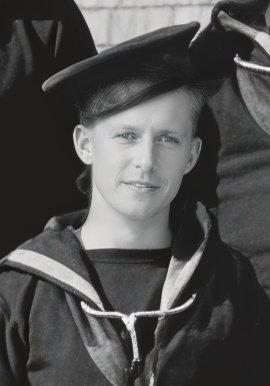
Geale (2nd row, 2nd from left)






- World War I - Menu
- WWI Stories and Articles
- Photos - Yarmouth Soldiers
- Selection of World War I Songs
- WWI Casualties of Yarmouth, NS
- Those Who Served - Yarmouth, NS
- WWI Casualties Digby Co. NS
- WWI Casualties Shelburne Co. NS
- Merchant Mariners (1915) Yarmouth, NS
- Canadian Forestry Corps - Non Yarmouth Birth/Residence Enlistments
- US Draft Registry - Yarmouth NS Born


- World War II - Menu
- WWII Stories and Articles
- Telegraphist Air Gunners
- WWII Casualties of Nova Scotia
- US Casualties with NS Connection
- Far East/Pacific Casualties with NS Connection
- Merchant Navy Casualties Nova Scotia
- Nova Scotia WWII Casualties Holten Canadian War Cemetery
- D-Day Casualties - Nova Scotia
- CANLOAN Program Casualties - Nova Scotia
- Battle of the Bulge Casualties - Nova Scotia
- WWII Casualties Yarmouth NS
- Yarmouth Casualties - RCAF RAF Canadian Army WWII
- Yarmouth Co., Marrages WWII
- Casualties Non-Born/Residents with Connection to Yarmouth Co., Nova Scotia.
- WWII Casualties Digby Co., NS
- Non-Nova Scotian WWII Casualties Buried in Nova Scotia
- WWII RCAF Casualties Aged 16-18
- Brothers/Sisters Who Served - World War II