Remembering the Telegraphist Air Gunners
East Camp

copyright © Wartime Heritage Association
Wartime Heritage
ASSOCIATION
A Walk Through History
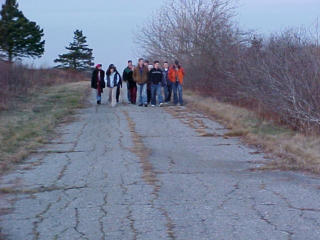
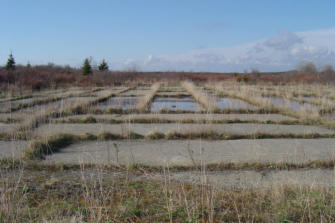
Over the years I have walked the pathways and the platforms of what was, between 1942 and 1945, the Fleet Air Arm
Royal Navy Base that was East Camp located in the area across from the present Yarmouth Airport.
My first trips to the site were in spring and summer of 1987 as I was
writing the scripts for “Meet the Airmen” a stage production about East
and West Camps, West Camp being the RCAF Station at Yarmouth during
WWII. At that time I was trying to recreate the story of wartime Yarmouth
with so little knowledge. As I walked those pathways at that time I tried
to imagine East Camp as it was in the 1940s and the British recruits that
lived and trained there during the war. There was a photo in a family
album of a young TAG, Bill West, my only direct connection to what was
East Camp.
Little did I realize at that time the connections that would be made
in the years ahead; the Telegraphist Air Gunners that as teenagers trained in Yarmouth or their family members that I would
meet, my association with TAGA (the Telegraphist Air Gunners Association in England) as an associate member or my visits to
England, especially to Gosport and Portsmouth the home of the Fleet Air Arm Royal Navy. In 1987, I never for a moment
considered that I would talk and write to Bill West, or meet his family, that I would meet Les Sayer in England, the
Telegraphist Air Gunner that was on the plane that disabled the Bismarck; Eric May that would I meet and visit in England and
he would visit with me in Yarmouth; Leslie Hodges who would spend a week with me returning to visit the place where he
trained as an eighteen year old and who would call me on Sunday evenings until his death in 2012.
My last visit to East Camp was with the son and daughter of William
Jacks, Leading Air Mechanic, Fleet Air Arm Royal Navy, who was in Yarmouth
at East Camp during the war. On that occasion we were told we were
trespassing on private property and would have to leave. I have not been
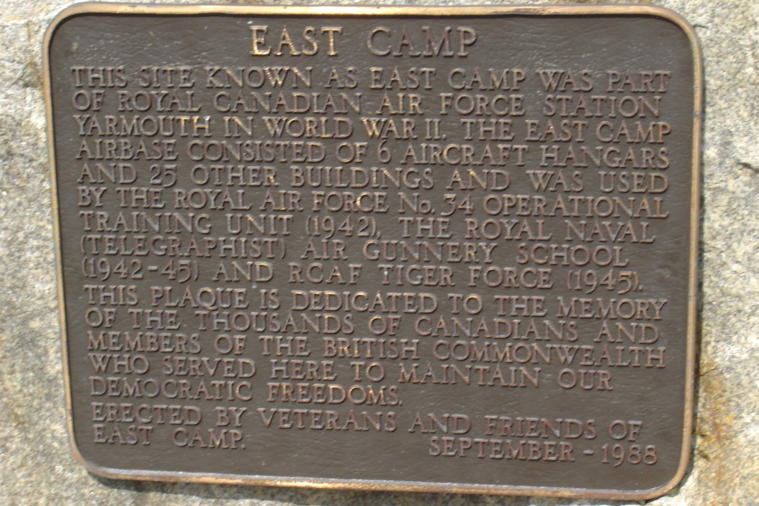
back since; however, there is a monument on the site to the history of the
TAGs that can be visited, which I suspect few know exists. Our search for
the location of the Air Mechanic Building was perhaps too close to rock weed
or Irish moss drying on the old tarmac. I doubt if the person who spoke with
us had any idea of the history of the place or why someone would travel
thousands of miles to walk the area.
In December of 2003, the cast and crew of “Time To Remember”
visited the site on December 22. They would perform for the first time at
Gosport, England for the Telegraphist Air Gunners Association in May of
2004. It was opportunity to remember that the first course of TAGs first arrived on December 25, 1942.
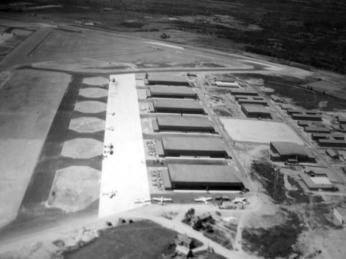
The history of the site is unique to Canada and to Yarmouth. East Camp was a part of the World War II RCAF Station,
Yarmouth, Nova Scotia. The Camp was located on a twenty-acre area of the airport with a main entrance from the Chebogue
Road in the Arcadia area of Yarmouth County. The Camp included forty buildings, including aircraft hangars, messes, and
quarters for the men. The buildings were arranged on a sloping hill upward to the hangars and main runways. Construction
began in 1941 by an Ontario construction Company using local men. British Columbian fir was used to construct the hangars.
Messes and quarters were built from wood cut and milled in south western Nova Scotia. Metal parts used in the construction
were machined at the Hebron Shoe Factory. Approximately ten teams of carpenters, consisting of fifteen to twenty men with
a foreman. Local carpenters were used from Yarmouth, Wedgeport, Carleton, Port Maitland, and the Work was carried out on
one building at a time until completed.
No 45A was the first TAG course. They arrived in Yarmouth by train
from Halifax departing from HMS St Vincent in Gosport, England. About 250
RAF personnel, a detachment from No 34 OTU (Operational Training Unit),
Pennfield Ridge, New Brunswick, occupied other quarters in East Camp for
several months after No 1 NAGS was officially formed on January 1, 1943.
The base was used for training Telegraphist Air Gunners, Fleet Air Arm, Royal
Navy as part of the British Commonwealth Air Training Plan. It was a unique
multi-service school with both ground and air training by the Royal Navy and
administration by the Royal Canadian Air Force.
The main base for Telegraphist Air Gunners was located at Worthy
Downs, Portsmouth, England. British recruits in England were divided into two
groups, some to be trained in Yarmouth, Nova Scotia, Canada, and the others trained at Worthy Down, Hampshire, England.
Ground school and in-flight training took about ten months. Ground training was supervised by Royal Navy Petty Officers in
the School Training Centre. The TAGs received training in Morse code, Radio Operations, Discipline, Gunnery, Naval regulations, and
Flight Experience. In-flight air experience included proper sending and receiving communication techniques and air gunnery
training while flying as crew in Fairey Swordfish and Avro Anson aircraft. The pilots were from the Royal Navy Fleet Air Arm, RCAF,
RNZNVR and the RNZAF. The goal of training was to produce air gunners for use on British aircraft carriers.
Since 1987, the history of TAGs has become for Wartime Heritage an ongoing venture to remember our wartime history. We
have learned about Merchant Aircraft Carriers - MAC Ships though out connections to Fred Good; the story of the Pacific Fleet
through Bill West; the story of the TAG called “Canada”; the contribution to history of Anthony Kenneth Johnson, the father of
Pieter Johnson; and the story of the Palembang Nine; the Channel Dash; of the contribution of the war effort by Lionel Reginald
James and so many other stories that connect the Town of Yarmouth to World War II.
In our modern world, the remembrance of the past is so important because, with time, our Town and County contribution to
wartime history continues to fade away. Remembering the TAGs who trained in Yarmouth as part of our history and our contribution
to the freedom of the world during WWII needs to be remembered.
Written by George Egan
Chairman, Wartime Heritage






- World War I - Menu
- WWI Stories and Articles
- Photos - Yarmouth Soldiers
- Selection of World War I Songs
- WWI Casualties of Yarmouth, NS
- Those Who Served - Yarmouth, NS
- WWI Casualties Digby Co. NS
- WWI Casualties Shelburne Co. NS
- Merchant Mariners (1915) Yarmouth, NS
- Canadian Forestry Corps - Non Yarmouth Birth/Residence Enlistments
- US Draft Registry - Yarmouth NS Born


- World War II - Menu
- WWII Stories and Articles
- Telegraphist Air Gunners
- WWII Casualties of Nova Scotia
- US Casualties with NS Connection
- Far East/Pacific Casualties with NS Connection
- Merchant Navy Casualties Nova Scotia
- Nova Scotia WWII Casualties Holten Canadian War Cemetery
- D-Day Casualties - Nova Scotia
- CANLOAN Program Casualties - Nova Scotia
- Battle of the Bulge Casualties - Nova Scotia
- WWII Casualties Yarmouth NS
- Yarmouth Casualties - RCAF RAF Canadian Army WWII
- Yarmouth Co., Marrages WWII
- Casualties Non-Born/Residents with Connection to Yarmouth Co., Nova Scotia.
- WWII Casualties Digby Co., NS
- Non-Nova Scotian WWII Casualties Buried in Nova Scotia
- WWII RCAF Casualties Aged 16-18
- Brothers/Sisters Who Served - World War II