copyright © Wartime Heritage Association
Website hosting courtesy of Register.com - a web.com company
Wartime Heritage
ASSOCIATION

Remembering World War II
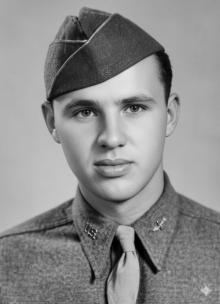
Leslie Robert Durkee

Name:
Leslie Robert Durkee Jr.
Rank:
Second Lieutenant
Service Number:
O-717404
Service:
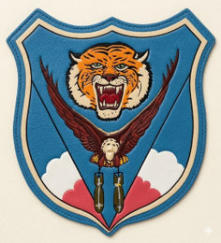
490th Bomber Squadron 341st Bomber Group
United States Army Air Force
Awards:
Air Medal, Purple Heart
Date of Birth:
September 11, 1924
Place of Birth:
Swampscott, Essex County, Massachusetts
Address at Enlistment:
Essex County, Massachusetts
Date of Death:
May 30, 1945
Age:
20
Memorial:
Manila American Cemetery and Memorial, Philippines
Reference:
Tablets of the Missing
Leslie Robert Durkee Jr. was the son of Leslie Robert Durkee (1895-1941) and Marion Harvie (Underwood)
Durkee (1898-1965), and the husband of Gladys Jean Franklin (1926-1961). His siblings were Raymond Jesse
Durkee (1923-2008), Leon Carl Durkee (1926-2009), and Clayton Allen Durkee (1930-1996).
Leslie’s father was born in Ohio, Yarmouth County, Nova Scotia.
His brother Raymond served as a Motor Machinist 1st Class in the US Navy in WWII, including service in the
Philippines. His brother Leon, Sergeant, served in the USAAF, including a posting in California.
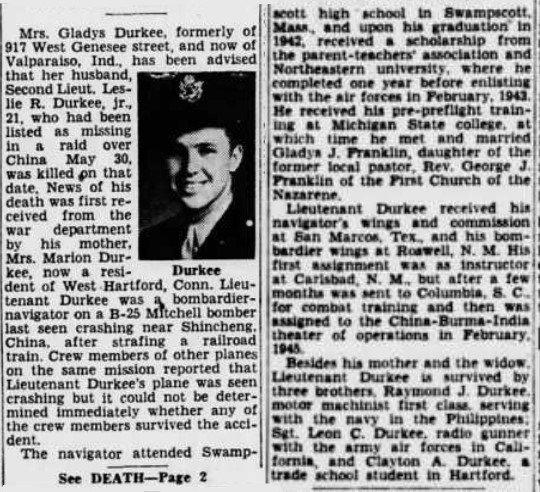
Private Leslie Robert Durkee enlisted and trained in the USAAF in WWII. He
was killed in action in Zhejiang, China on May 30, 1945. He served with
the 490th Bomber Squadron, 341st Bomber Group (Medium), aboard the B-
25J Mitchell #43-27810. The 490th was nicknamed the “Burma Bridge
Busters”.
The 490th operated in the China-Burma-India (CBI) theater, frequently
called the "Forgotten Theater" because it was routinely starved of
replacement parts, fuel, and new aircraft compared to Europe and the
wider Pacific.
The Japanese military relied heavily on the sweeping railway systems of
Burma and occupied China to move troops, ammunition, and supplies to
the front lines. Standard high-altitude bombing was largely ineffective against narrow, reinforced concrete and
steel railway bridges.
To solve this, the 490th pioneered a highly dangerous tactic known as "glip" bombing (or skip-bombing). Flying
their twin-engine B-25 Mitchells at treetop level, sometimes just 50 to 100 feet above the ground, pilots would
race down the path of the river or railway line, dodge intense ground fire, and release their bombs at point-
blank range so they would slide or skip directly into the bridge abutments. Between 1943 and 1945, the
squadron flew over 600 missions, destroying nearly 200 vital enemy bridges and completely disrupting
Japanese logistics.
By April 1945, the war in Burma was winding down, and the 490th was reassigned to Hanchung (Hanzhong),
China, coming under the operational control of the 14th Air Force (the legacy theater of General Claire
Chennault's "Flying Tigers"). From this new base, the squadron's mission shifted to severing the remaining
Japanese escape routes, supply corridors, and rail yards across occupied China. The flying conditions here
were grueling, requiring navigation of mountainous terrain, unpredictable weather, and heavily defended
transportation hubs.
B-25J #43-27810 took off from Hanzhong alongside a formation of other B-25s for a low-level strafing and
bombing mission over the ‘Sincheng’ railroad bridge.
After completing a successful bombing run, the crew of B-25J #43-27810 returned to the bridge to strafe
nearby railroad cars. During this second pass, the aircraft was apparently hit by enemy anti-aircraft fire and
crashed approximately two miles southeast of the railroad bridge.
The entire six-man crew was lost in the crash, including Durkee and the following crew:
First Lieutenant Robert Alan Hansen
Pilot, born in Brooklyn Co., New York in 1924
Sergeant Joseph M. Hinds
Engineer, born in Maine in 1913
First Lieutenant Emile Albert Larrecou, Jr.
Co-Pilot, born in San Francisco, California in 1921
Sergeant Chester Frederick Rouillard, Jr.
Radio Operator, born in Malden, Massachusetts in 1925
Sergeant Paul H. Van Wart
Gunner, born in Boston, Massachusetts in 1922
Leslie is also remembered on the WWII Memorial in Swampscott, Essex Co., Massachusetts.

Sources
American Battle Monuments Commission – Leslie R. Durkee Jr.
U.S., Defense POW/MIA Accounting Agency, Unaccounted-for Remains, Group A (Recoverable), 1941-1975
U.S., Headstone and Interment Records for U.S., Military Cemeteries on Foreign Soil, 1942-1949Preview
U.S., World War II and Korean Conflict Veterans Interred Overseas






- World War I - Menu
- WWI Stories and Articles
- Photos - Yarmouth Soldiers
- Selection of World War I Songs
- WWI Casualties of Yarmouth, NS
- Those Who Served - Yarmouth, NS
- WWI Casualties Digby Co. NS
- WWI Casualties Shelburne Co. NS
- Merchant Mariners (1915) Yarmouth, NS
- Canadian Forestry Corps - Non Yarmouth Birth/Residence Enlistments
- US Draft Registry - Yarmouth NS Born


- World War II - Menu
- WWII Stories and Articles
- Telegraphist Air Gunners
- WWII Casualties of Nova Scotia
- US Casualties with NS Connection
- Far East/Pacific Casualties with NS Connection
- Merchant Navy Casualties Nova Scotia
- Nova Scotia WWII Casualties Holten Canadian War Cemetery
- D-Day Casualties - Nova Scotia
- CANLOAN Program Casualties - Nova Scotia
- Battle of the Bulge Casualties - Nova Scotia
- WWII Casualties Yarmouth NS
- Yarmouth Casualties - RCAF RAF Canadian Army WWII
- Yarmouth Co., Marriages WWII
- Casualties Non-Born/Residents with Connection to Yarmouth Co., Nova Scotia.
- WWII Casualties Digby Co., NS
- Non-Nova Scotian WWII Casualties Buried in Nova Scotia
- WWII RCAF Casualties Aged 16-18
- Brothers/Sisters Who Served - World War II